
Manage Custom Fields
Alation Cloud Service Applies to Alation Cloud Service instances of Alation
Customer Managed Applies to customer-managed instances of Alation
Important
You are viewing documentation for Alation’s Classic User Experience.
Custom fields are user-defined fields that can be added to templates. This page describes how to manage custom field definitions.
You must have the Catalog Admin or Server Admin role to manage custom fields.
For information on the types of templates and custom fields, see About Templates and Fields. For information on how to add custom fields to templates, see Manage Templates.
Create or Edit a Custom Field
To create a custom field:
Click on the Settings icon in the top right corner.


The Admin Settings page appears. Under the Customization section, click Custom Fields & Permissions. The Custom Fields & Permissions page appears.
Catalog Admins: A dropdown menu appears. Click Customize Catalog.
Server Admins: The Admin Settings page appears. Under the Catalog Admin section, click Customize Catalog.
The Custom Fields page appears.
Do one of the following:
To create a custom field, click Create Field at the top right of the page. In the Select Field Type step, choose the type of field you want to create. For descriptions of each type, see Custom Field Types.
To edit a custom field, click the field’s row in the table. The field editor opens.
The screenshot below shows the custom field editor for a new object set field. The available settings depend on the type of field you’re creating or editing.
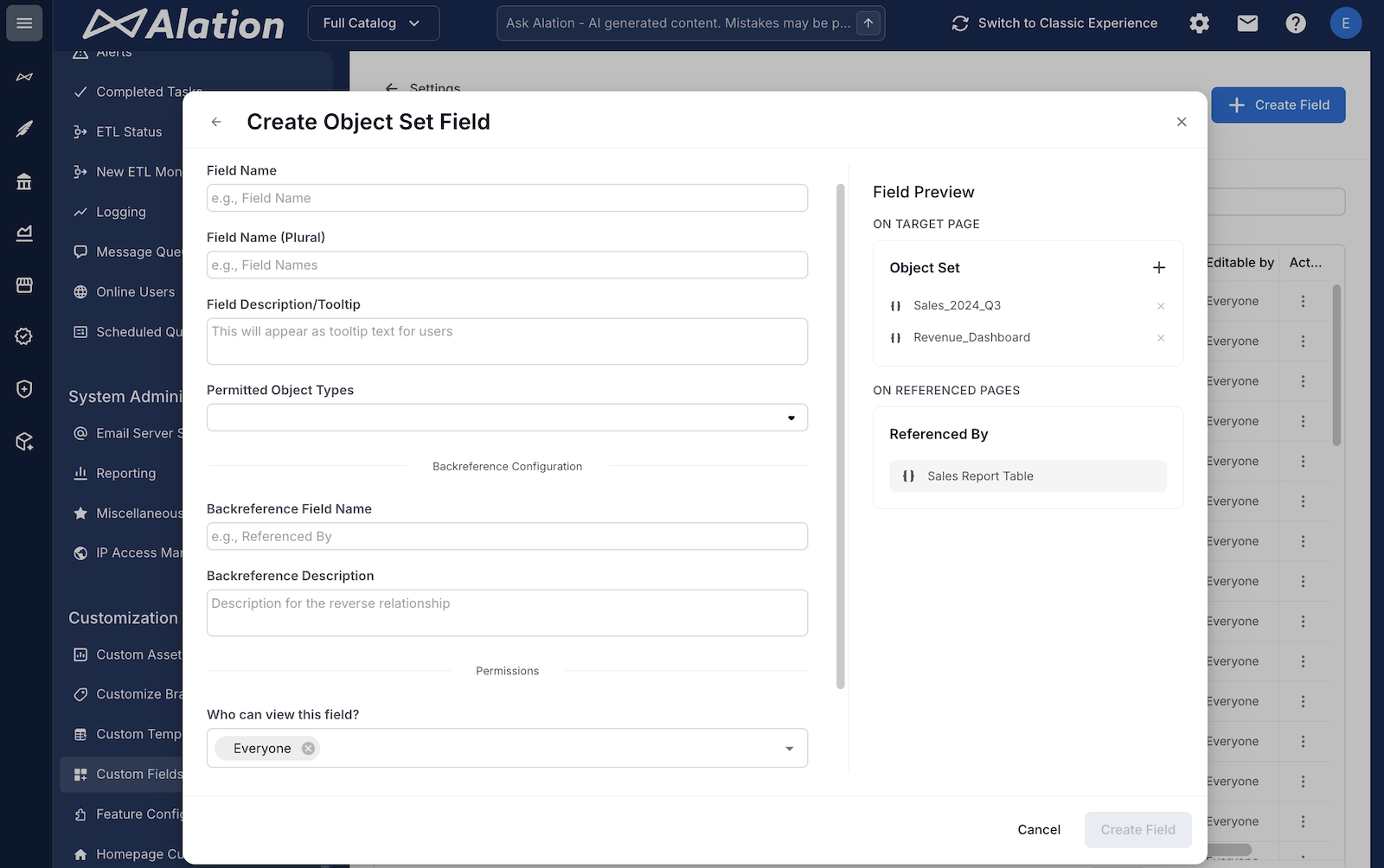
Enter or edit the field’s settings in the left panel of the editor. The available settings depend on the field type and can include:
Field Name: The name of the field.
Important
If you are using Alation Analytics, the Field Name should be less than
64characters. This is due to a limitation in Postgres that limits column names to64characters. If you exceed this limit, the custom field will not be available in Alation Analytics.Field Name (Plural): The plural form of the field name, used for fields that can hold multiple values.
Field Description/Tooltip: Optional. The text that appears as a tooltip when you hover over the field.
Permitted Object Types: For object set and object reference fields, select the object types that can be added to the field. See Object Set for the full list of supported object types.
Backreference Configuration: For object set and object reference fields, enter the Backreference Field Name and an optional Backreference Description for the link shown on the target object’s page.
Field Options: For picker and multi-select picker fields, add, reorder, and remove the options that users can select.
Permissions: Set who can view and edit the field. See Add Permissions to a Custom Field.
Note
BI object types (BI Folders, BI Reports, BI Report Columns, BI Data Sources, and BI Data Source Columns) are available as Permitted Object Types by default. Availability is controlled by the server-side configuration flag
alation.feature_flags.enable_bi_object_set_targets, which isn’t exposed in Feature Configuration.On Customer-Managed instances, a Server Admin can turn it off using
alation_conf:alation_conf alation.feature_flags.enable_bi_object_set_targets -s False
For details, see Use alation_conf.
On Alation Cloud Service, request server configuration changes through Alation Support.
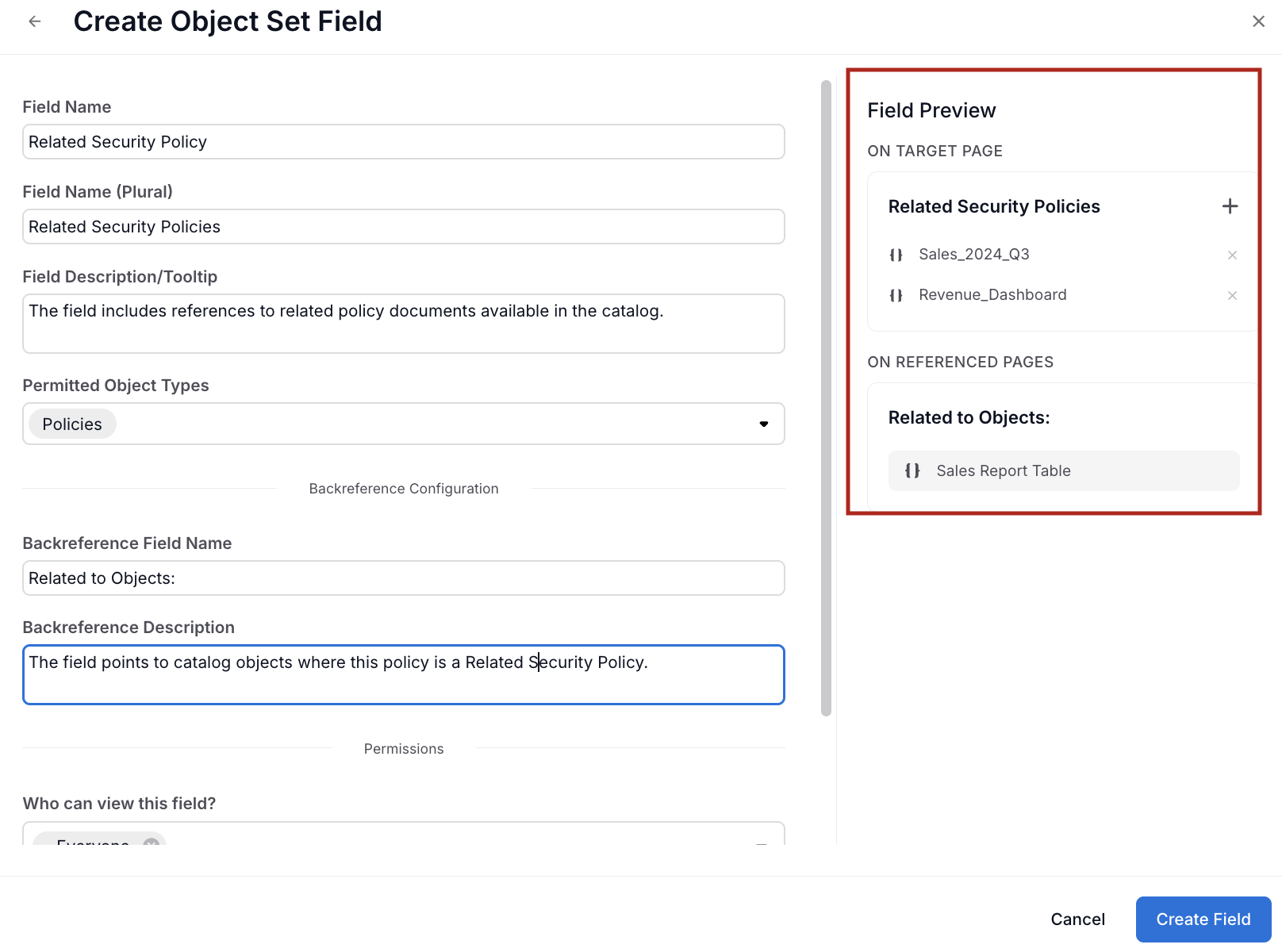
The Field Preview panel on the right shows how the field will appear on a catalog page. The screenshot below shows the field preview for an object set field.
Click Create Field (or Save Changes when editing) to save the field.
Click on the Settings icon in the top right corner.
The Admin Settings page appears. Under the Customization section, click Custom Fields & Permissions. The Custom Fields & Permissions page appears.
Catalog Admins: A dropdown menu appears. Click Customize Catalog.
Server Admins: The Admin Settings page appears. Under the Catalog Admin section, click Customize Catalog.
The Custom Fields page appears.
The types of custom fields are listed on the left side of the page. Scroll to find the type of custom field you need.
To create a custom field, click the plus icon next to the type of custom field you want to create.
To edit a custom field, click the custom field name.
Enter or edit the custom field properties. The properties depend on the type of custom field you are creating. The following sections describe the properties for each type of custom field.
Important
If you are using Alation Analytics, the Name (singular) property for custom fields should be less than 64 characters. This is due to a limitation in Postgres that limits column names to 64 characters. If you exceed this limit, the custom field will not be available in Alation Analytics.
Object Set Properties
on the Target Page: These properties apply to the object page where the links are created.
Permitted Types: Click on Select Object Types and select the types of objects that can be added to the object set.
Name (plural): The name of the field in plural form.
Name (singular): The name of the field in singular form.
Tooltip Text: Optional. The text that appears when you hover over the field.
on the Source Page: These properties apply to the object pages that are referred to.
Backref Name: The name of the field that refers back to the page where the link was created.
Tooltip Text: Optional. The text that appears when you hover over the field.
People Set Properties
on the Target Page: These properties apply to the catalog page where the users and groups are selected.
Name (plural): The name of the field in plural form.
Name (singular): The name of the field in singular form.
Tooltip Text: Optional. The text that appears when you hover over the field.
on the Source Page: These properties apply to the user or group profile page.
Backref Name: The name of the field that refers back to the page where the link was created.
Tooltip Text: Optional. The text that appears when you hover over the field.
Reference Properties
on the Target Page: These properties apply to the object page where the link is created.
Permitted Types: Click on Select Object Types and select the types of objects that can be referred to.
Name: The name of the field.
Tooltip Text: Optional. The text that appears when you hover over the field.
on the Source Page: These properties apply to the object page that is referred to.
Backref Name: The name of the field that refers back to the page where the link was created.
Tooltip Text: Optional. The text that appears when you hover over the field.
Picker Properties
Name: The name of the field.
Tooltip Text: Optional. The text that appears when you hover over the field.
Options: The options that can be selected on a catalog page that contains this field.
To add an option, click Add Option. Enter the option name and click away from the field to add the option to the list.
To delete an option, hover over the option and click the X icon. The option is removed immediately.
To reorder the options, hover over an option and click the up or down arrow.
Multi-Select Picker Properties
Name (plural): The name of the field in plural form.
Name (singular): The name of the field in singular form.
Tooltip Text: Optional. The text that appears when you hover over the field.
Options: The options that can be selected on a catalog page that contains this field.
To add an option, click Add Option. Enter the option name and click away from the field to add the option to the list.
To delete an option, hover over the option and click the X icon. The option is removed immediately.
To reorder the options, hover over an option and click the up or down arrow.
Rich Text Properties
Name: The name of the field.
Tooltip Text: Optional. The text that appears when you hover over the field.
Date Properties
Name: The name of the field.
Tooltip Text: Optional. The text that appears when you hover over the field.
When you’re done, click the green checkmark icon
 at the top right of the editor to save the custom field.
Add a Custom Field to a Template
You can add a custom field to a template by editing the template. The way you do this depends on the type of template. For more information, see Edit a Template.
Add Permissions to a Custom Field
To add permissions to a custom field:
Click on the Settings icon in the top right corner.
The Admin Settings page appears. Under the Customization section, click Custom Fields & Permissions. The Custom Fields & Permissions page appears.
Catalog Admins: A dropdown menu appears. Click Customize Catalog.
Server Admins: The Admin Settings page appears. Under the Catalog Admin section, click Customize Catalog.
The Custom Fields page appears.
Click the field you want to set permissions for. The field editor opens.
In the Permissions section:
Under Who can view this field?, select the groups and people sets that can view the field. Leave it empty to keep the field viewable by Everyone.
Under Who can edit this field?, select the groups and people sets that can edit the field. Leave it empty to keep the field editable by Everyone.
Note
When you open a built-in field, only the Permissions section is available, and you can restrict editing only. Built-in fields are always viewable by all users on all templates.
Click Save Changes.
Click on the Settings icon in the top right corner.
The Admin Settings page appears. Under the Customization section, click Custom Field Permissions.
Catalog Admins: A dropdown menu appears. Click Customize Catalog, then click the Custom Field Permissions tab.
Server Admins: The Admin Settings page appears. Under the Catalog Admin section, click Customize Catalog, then click the Custom Field Permissions tab.
The Custom Field Permissions tab has two tables: Custom Field on top and Builtin Field below. To change permissions for custom fields, you will be working with the Custom Field table. To change permissions for built-in fields, scroll down to the Builtin Field table.

Find the field you want to add permissions to. Under the column for the type of permission you want to assign, click the Add Rule link. This will open a list of available groups and people sets.
Note
You can restrict editing of built-in fields, but not viewing. Built-in fields are always viewable by all users on all templates.
Select groups and people sets from the list.
Remove Permissions from a Custom Field
To remove permissions from a custom field:
Click on the Settings icon in the top right corner.
The Admin Settings page appears. Under the Customization section, click Custom Fields & Permissions. The Custom Fields & Permissions page appears.
Catalog Admins: A dropdown menu appears. Click Customize Catalog.
Server Admins: The Admin Settings page appears. Under the Catalog Admin section, click Customize Catalog.
The Custom Fields page appears.
Click the field you want to change permissions for. The field editor opens.
In the Permissions section, under Who can view this field? or Who can edit this field?, click the X on the chip for the group or people set you want to remove. To return a field to being viewable or editable by Everyone, remove all selections for that permission.
Click Save Changes.
Click on the Settings icon in the top right corner.
The Admin Settings page appears. Under the Customization section, click Custom Field Permissions.
Catalog Admins: A dropdown menu appears. Click Customize Catalog, then click the Custom Field Permissions tab.
Server Admins: The Admin Settings page appears. Under the Catalog Admin section, click Customize Catalog, then click the Custom Field Permissions tab.
The Custom Field Permissions tab has two tables: Custom Field on top and Builtin Field below. To change permissions for custom fields, you will be working with the Custom Field table. To change permissions for built-in fields, scroll down to the Builtin Field table.
Find the field you want to remove permissions from. Click the X icon next to the group or people set you want to remove.

Delete a Custom Field
To delete a custom field:
Click on the Settings icon in the top right corner.
The Admin Settings page appears. Under the Customization section, click Custom Fields & Permissions. The Custom Fields & Permissions page appears.
Catalog Admins: A dropdown menu appears. Click Customize Catalog.
Server Admins: The Admin Settings page appears. Under the Catalog Admin section, click Customize Catalog.
The Custom Fields page appears.
Find the custom field in the table. Use the search box or filters to locate it.
Click the actions (three-dots) icon at the end of the field’s row, then select Delete Field.
In the Delete Custom Field dialog, click Delete to confirm. The field is deleted.
Note
Only custom fields can be deleted. Built-in fields and fields synced from an external source don’t have a Delete Field option.
Click on the Settings icon in the top right corner.
The Admin Settings page appears. Under the Customization section, click Custom Fields & Permissions. The Custom Fields & Permissions page appears.
Catalog Admins: A dropdown menu appears. Click Customize Catalog.
Server Admins: The Admin Settings page appears. Under the Catalog Admin section, click Customize Catalog.
The Custom Fields page appears.
The custom fields are listed on the left side of the page. Scroll to find the custom field you want to delete.
Click the custom field’s name. The custom field editor will open on the right.
Click the trash can icon
 at the top right of the editor.
In the confirmation dialog that appears, confirm the deletion. The field is deleted.