
Configure Chat with Data Product
Alation Cloud Service Applies to Alation Cloud Service instances of Alation
With Chat with Data Product, you can explore your data product by asking questions in natural language. Instead of writing SQL, you describe what you want to know, and the chat returns reports, summaries, and other data-driven insights based on the underlying dataset. You connect using your own database credentials, so you only see data you’re authorized to access in the cataloged data sources.
Data product creators and users with Data Product Admin access can enable Chat for the data products they manage.
For example, consider a data product built on the Alation Analytics database to analyze user activity across the Alation catalog. This data product might include tables related to page visits and Compose query usage. The Chat can help answer questions such as:
How many times was a specific catalog object page visited?
How many new users accessed the catalog daily?
Which visitors viewed catalog pages within a specified timeframe?
Which users executed Compose queries within a date range?
What is the trend of page visits over time?
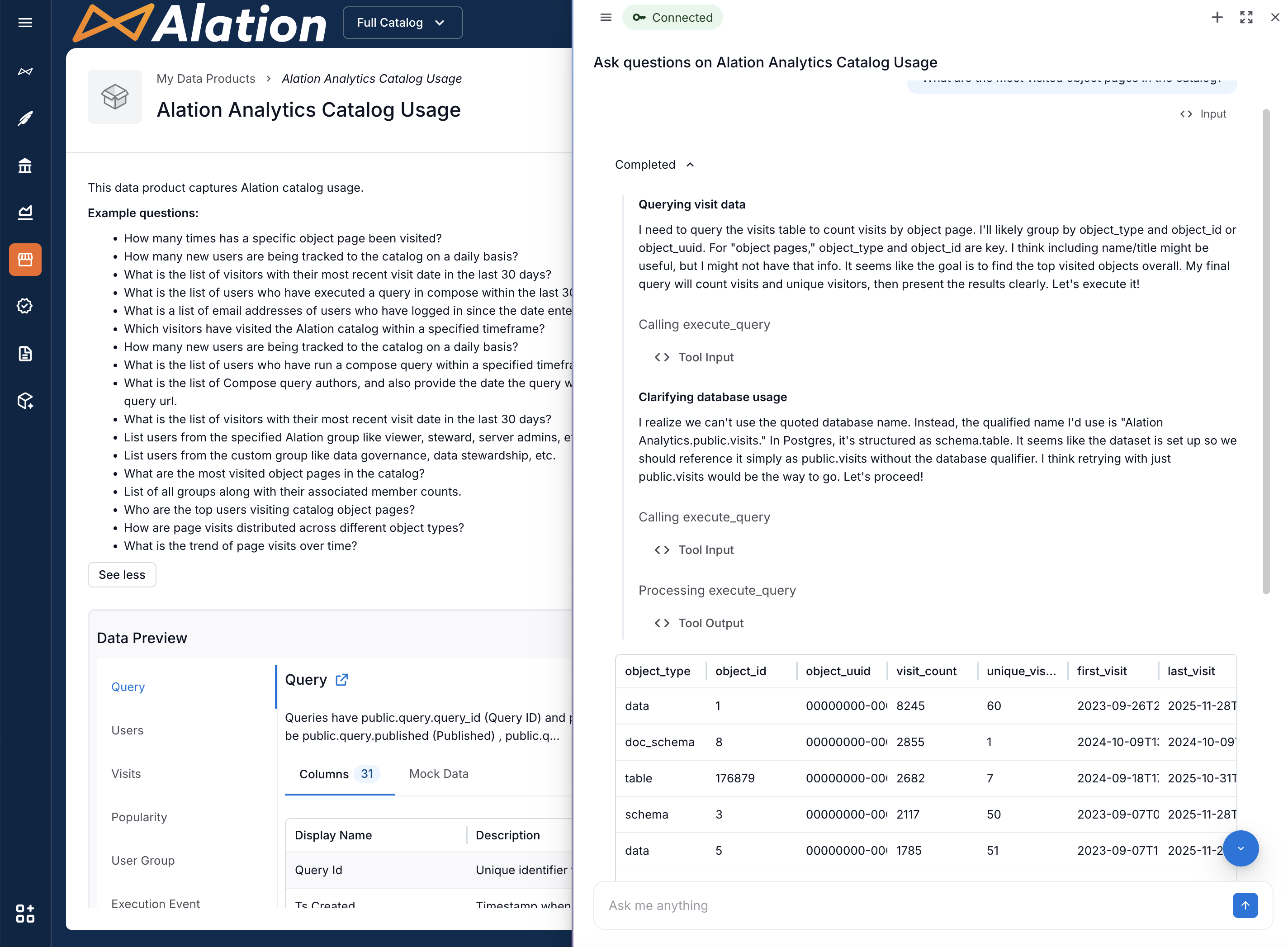
The responses are delivered as ready-to-use reports enriched with AI-generated summaries. Users can expand each response to see the AI thought process and the generated SQL.
The screenshot below demonstrates how Chat returns a data-driven response to a user’s question.
In this topic:
Verify the Connection URI
Before enabling the Chat, validate the deliverySystems Property in the Data Product specification.
Every data product must define the delivery system (deliverySystems) for the data, which represents the source database connection.
If datasets are added through the data product builder UI, these entries are generated automatically when you add tables to the data product.
Before enabling Chat, ensure that delivery systems are present and correct.
The following YAML example shows how the deliverySystems property is defined in a data product configuration:
deliverySystems:
  chat_with_postgresql:
    type: sql
    uri: postgresql://st-example.cluster.us-east-2.rds.amazonaws.com:5432/t_product_analytics
    accessRequestInstruction:
      type: manual
      instruction: Connect to the PostgreSQL database using the provided connection URI.
    postgresql:
      type: sql
      uri: postgresql://st-example.cluster.us-east-2.rds.amazonaws.com:5432/t_product_analytics
Configure Chat Authentication
Data Source Compatibility for Chat
Data Product Chat is supported for a specific subset of data sources. See Data Source Compatibility for Data Products for information on data sources compatible with the Data Product Chat.
Snowflake OAuth
If your data product is built on Snowflake and you want to use SSO authentication for Chat, configure Snowflake OAuth before enabling the Chat. See SSO with Snowflake for Data Product Chat for more information.
Snowflake Key Pair
The Data Products App supports key pair authentication for Snowflake data sources. This method provides an alternative to password-based authentication by using a pair of cryptographic keys to verify user identity.
To use key pair authentication, you must generate a key pair and associate it with your Snowflake user. For detailed steps, see the Snowflake documentation.
Important
Keep track of your public key file and the passphrase, if one is set.
Save your key using one of the following supported file extensions: .p8, .pem, .key, or .txt.
Each Snowflake user who needs to connect to a Snowflake data product from Alation must complete this setup individually.
To configure key pair authentication for the data product chat, follow the steps in Enable the Chat for a Data Product.
After key pair authentication is enabled, users who initiate a chat with the data product will be prompted to upload their key file and, if applicable, provide the associated passphrase.
Google BigQuery Service Account
If your data product is built on Google BigQuery, configure service account authentication before enabling Chat. See Google BigQuery Service Account Authentication for Data Products for more information.
Basic Authentication with Supported Data Sources
Before users can interact with the data sources via the Data Product Chat, ensure the following conditions are met:
Database-Level Permissions
Users must have the appropriate privileges within the source system to read the data included in the data product. At a minimum, users typically require:
CONNECTpermissions to the database.USAGEpermissions on the relevant schemas.SELECTpermissions on all tables or views included in the data product.
Valid Credentials
Users must have an active account (username and password) on the target system.
Teradata users: You may use standard database credentials or LDAP credentials.
Databricks users: Ensure you are using a personal access token or database-native credentials as configured by your workspace admin.
Link Authentication to the Data Product
To apply the authentication to your data product:
Open the Data Products App and select My Data Products.
In the Data Products table, locate your data product.
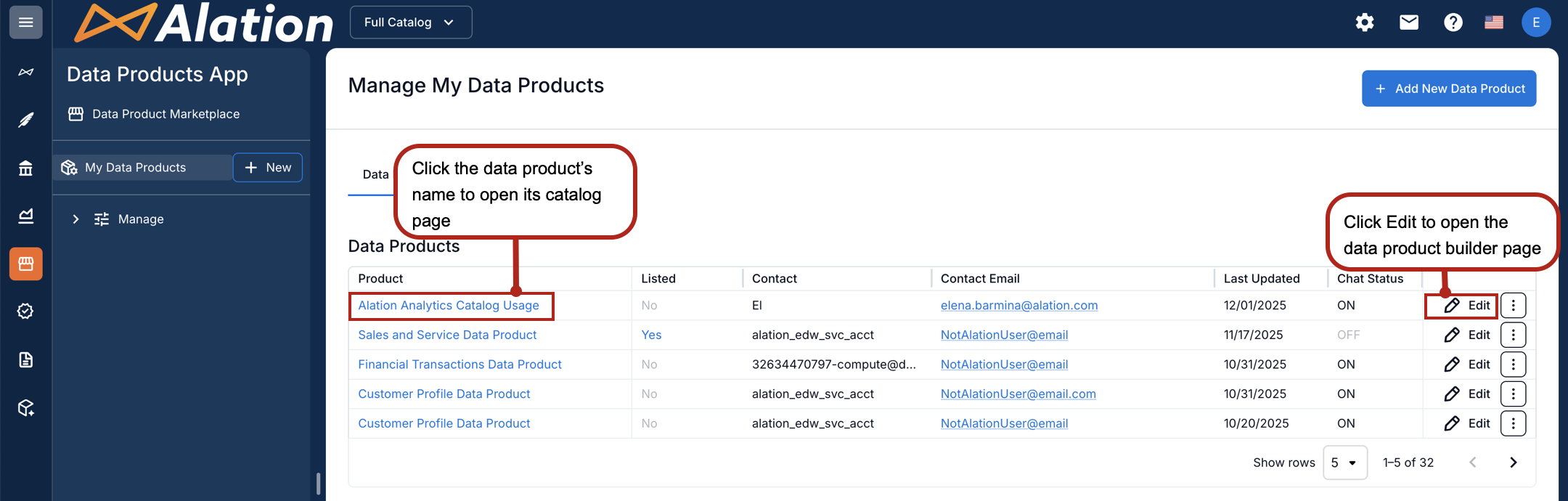
In the rightmost column, click Edit for this data product. The data products editor opens.
Select the Configure tab on top left.
Under Configure Connection, select Basic Authentication (Username/Password).
Evaluate Data Product Chat before enabling it for your users.
Evaluate Data Product Chat
Before enabling the Chat for your data product, you can assess the quality of the responses and verify that the experience is ready for users. See Evaluate Data Product Chat.
Enable the Chat for a Data Product
Use the Settings tab on the data product management page.
Note
If you don’t see the Settings tab, the Chat with Data Products feature may not be enabled on your Alation instance.
To enable the chat:
Ensure you’ve verified the connection URI and configured authentication.
Navigate to the Data Products App from the left-side navigation.
Select My Data Products.
Locate the data product to configure.
Open the data product Settings tab in one of the following ways:
From the Data Products table, click on the data product name to open the data product settings page. Click the Settings tab.
From the Data Products table, click the three-dot menu for the data product and select Manage Data Product to open the data product settings. Click the Settings tab.
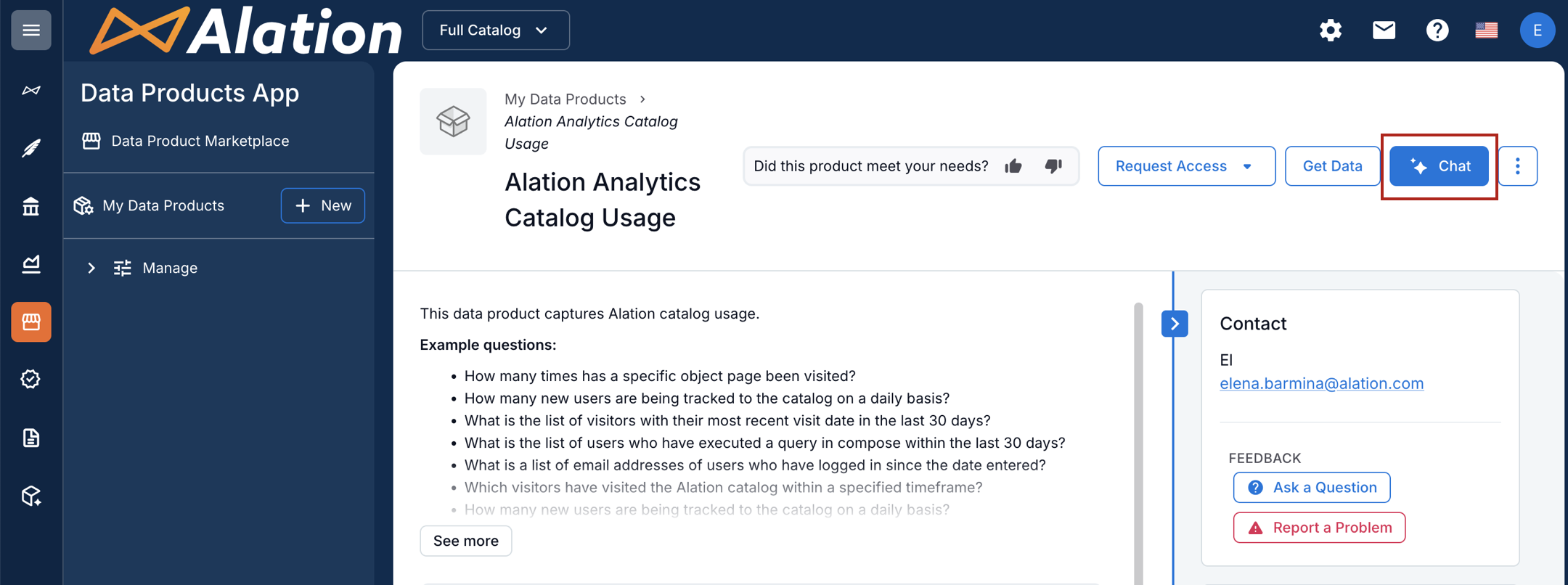
From the data product page (opened from the Marketplace or My Data Products), click the three-dot menu in the top right and select Configure Chat.
The Settings tab displays the Chat Configuration section.
Under Configure Connection, select one of the available authentication types depending on the data source you’re using. Refer to Data Source Compatibility for Data Products for information about the supported authentication types per data source.
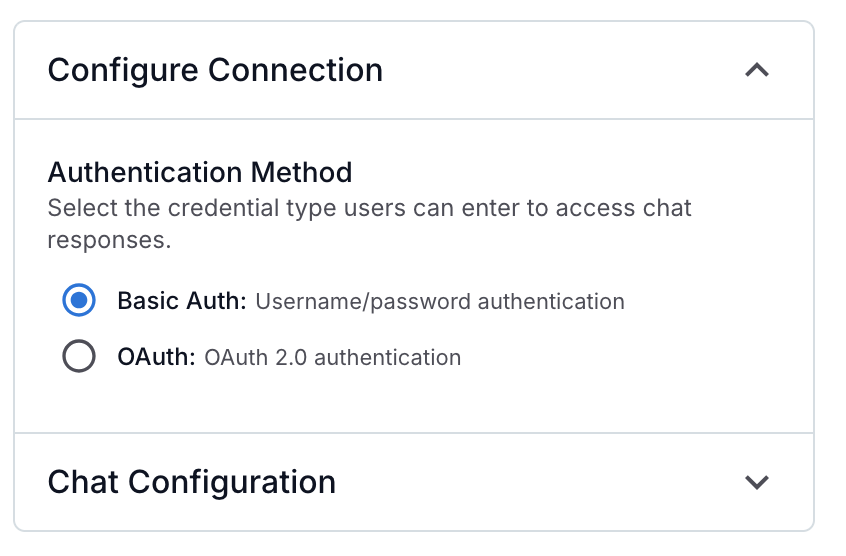
Turn on the Enable Chat toggle under Chat Configuration. The Chat option appears on the data product page for all authorized users.
Configure Chat in the Data Product Builder
You can also configure chat from the data product builder when you’re editing the data product specification directly:
Open the data product setting page of the required data product, click the Content tab.
Click Edit with Co-Pilot. The data product builder opens.
In the left-side navigation of the builder, click the Configure tab.

Expand Configure Connection and select the authentication type for your data source.
Expand Chat Configuration and click the Enable Chat toggle.
The Configure Connection and Chat Configuration sections in the builder offer the same options as the Chat Configuration section in the Settings tab.
Using Chat with a Data Product
When the Chat is enabled, any user with access to the data product can start using it to explore the underlying data. Chat is an AI-assisted feature that processes questions in natural language and uses an AI agent with several built-in AI tools to generate answers as reports and summaries. Each user has their own chat session and must authenticate to the database to see results, ensuring that responses respect their individual access rights.
To chat with a data product:
Open a data product from the Marketplace or My Data Products.
Click the Chat with <Data Product Name> button at the bottom of the page. The chat window opens.
At the top of the page, a connection indicator shows the current status:
Not connected to data: authentication required.
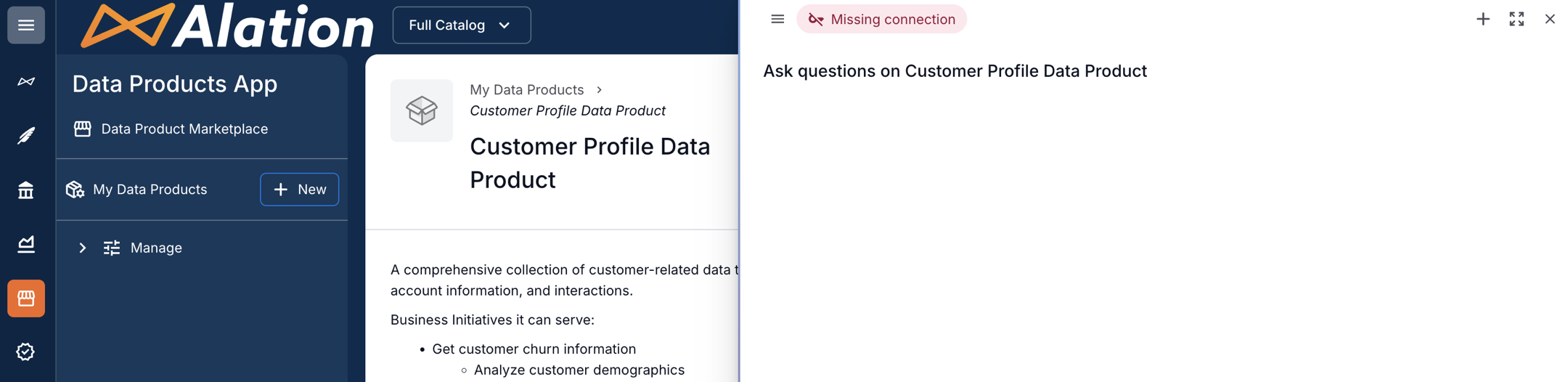
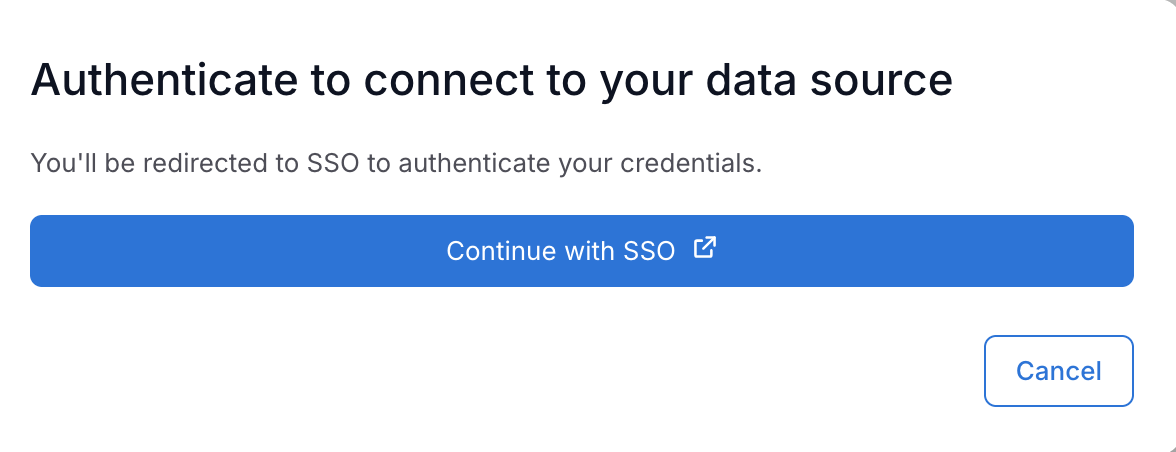
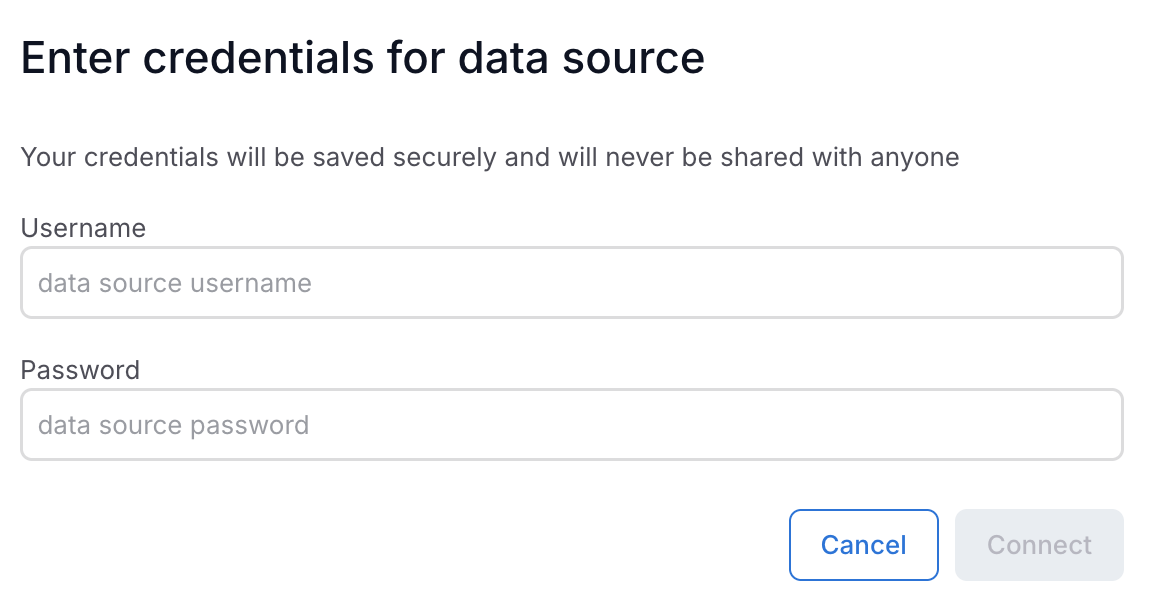
Authenticate using the supported method for the data product:
SSO (Snowflake): A dialog appears to authenticate via your configured identity provider. Click Continue with SSO to authenticate.
Basic Auth: A dialog appears to enter database credentials.
To use a custom URI, expand the Advanced Connection Settings section. Enter a custom database URI for the session. See Override the Default Connection URI.
Once authenticated, the indicator turns Connected to data.
Note
Connected to data means your credentials are saved for this chat session. It does not guarantee that the database connection is currently live. If the connection times out, the indicator can still show a connected state, and your next question may return an error. If this happens, reconnect or update your saved credentials from the connection indicator.
Ask questions about the data set of the data product. Type your question at the bottom of the panel and click the Send icon. The screenshot below shows a connected Chat that is ready for user input.
Override the Default Connection URI
The authentication dialog (for example, SSO and Basic Auth) includes an Advanced Connection Settings section. Expand it to view the Custom Database URI (Optional) field. The URI you enter here overrides the default connection URI from the data product’s delivery system for the current chat session only. It does not change the data product’s underlying configuration.
URI override works with any data source that the Data Products App supports for chat.
Use this field when you want to chat against the data product using a different role, warehouse, database, or host than the one the data product owner configured by default. This is useful when:
Your data source service account has access to multiple roles or warehouses, and you want to query as a specific role.
You want to point the session at a different database in the same data source (for example, Snowflake or Teradata) account.
You want to test a query against a different context before raising a change request to the data product owner.
Note
For Snowflake, Alation reads the following parameters from the URI (snowflake://<hostname>:<port>/?warehouse=<warehouse_name>&db=<db_name>&role=<role_name>) and applies them to the chat session:
warehouse: The Snowflake warehouse to use for queries.db(ordatabase): The Snowflake database to set as the session default.role: The Snowflake role to use for the session.
The URI format must match the expected format for the data source type (for example, teradata://<host>:<port>/<database> for Teradata).
To set a custom connection URI:
In the chat authentication dialog (for example, SSO or Basic Authentication), expand Advanced Connection Settings.
In the Custom Database URI (Optional) field, enter a URI using the format that matches your data source type. The prefix matches the data source type.
This field displays the default URI.
Here are examples of URI formats for some data sources:
For Snowflake:
snowflake://<account>.snowflakecomputing.com/?warehouse=<WAREHOUSE>&db=<DATABASE>&role=<ROLE>
For Teradata:
teradata://<host>:<port>/<database>
For Google BigQuery:
bigquery://https://www.googleapis.com/bigquery/v2:<Port_Number>;ProjectId=<Project_Id>
For Redshift:
redshift://<Hostname_or_IP>:<Port_Number>/<Database_Name>
Continue with the authentication flow (Continue with SSO for OAuth, or Connect for Basic Authentication) and click Update connection string to save the custom URI.
After you authenticate, the chat session uses the parameters from your custom URI in place of the data product defaults. If you leave the field empty, the chat session uses the data product’s default connection URI and displays Using default connection in the chat input area.
Note
If you enter a URI that doesn’t parse as a valid database URI, Alation displays an error message and prevents authentication until you correct the value.
Enrich Chat with Document Hubs Content
You can link Document Hubs content to the data product so the chat can draw on your organization’s authoritative definitions, formulas, and business rules when answering questions.
Linked content is referenced on demand during chat, not loaded in full into every answer. Retrieval respects each user’s Document Hubs permissions.
For configuration steps and guidance, see Configure Documentation for a Data Product.
Chat Actions and Controls
Review the AI Thought Process
As the AI answers your question, the chat streams its progress in expandable sections. While the AI is working, a section is labeled Thinking; when it finishes, it is labeled Completed. Expand a section to follow the agent’s reasoning and the SQL it generated, or collapse it to see just the answer.
Results appear below as a table you can page through, followed by a written summary. To export a table, click the Download table as CSV icon above it.
While a response is still generating, the Send icon in the chat input changes to a Stop icon. Click the Stop icon to cancel the current request, then enter a new question.

Open a New Chat Window
To open a new chat window, click the New Chat icon (the plus icon). If the Past chats panel is open, click New chat to start a new chat.
Close the Chat Window
To close the chat window, click the Close icon (X) on the top right of the chat window.
Review Chat History
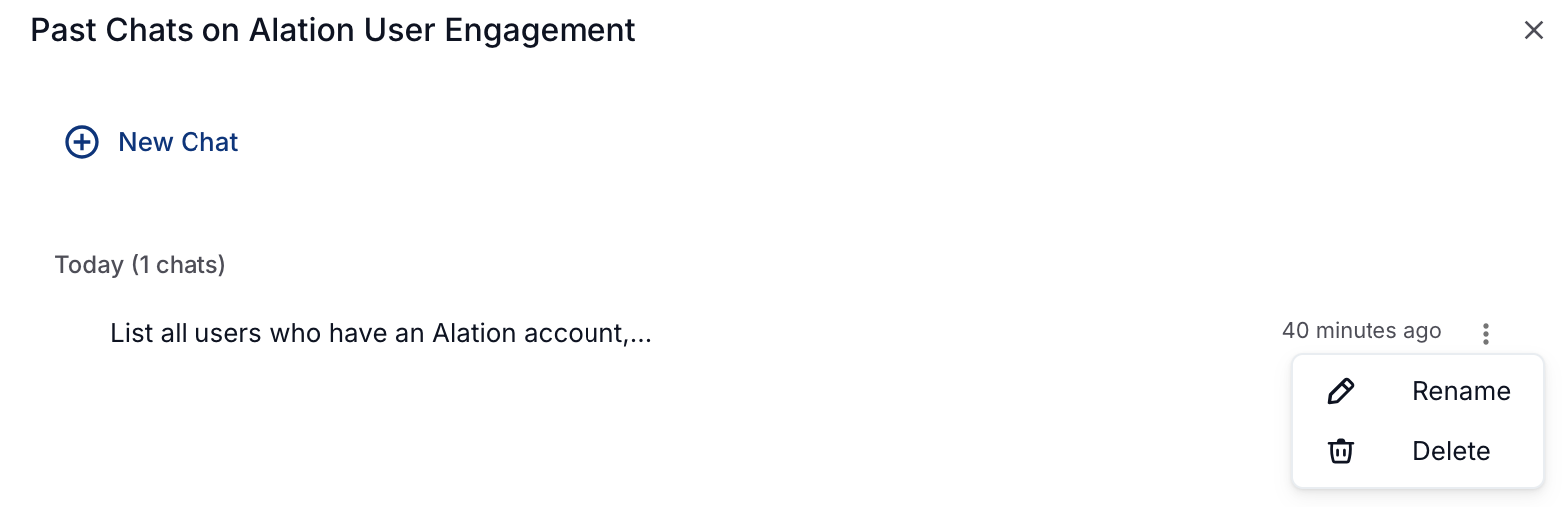
To review chat history, click the Expand icon on the left side of the chat window. The Past chats panel opens, displaying chat history.
You can rename, delete, or download a chat interaction using the Rename, Delete, and Download as PDF options for each. See Download a Chat as PDF.
Download a Chat as PDF
You can export a chat as a PDF from the chat window:
Click the Expand icon on the left side of the chat window to open Past chats and locate the chat you want to export.
Open the chat’s three-dot menu and select Download as PDF.
Alternatively, you can click the Download as PDF icon in the chat window to export the current chat session.
Alation generates a PDF of the chat, including all questions and responses along with the chat title and export date.
Work with Chat Feedback
Data product consumers may choose to send feedback about their chat experience to Data Product Admins. See Manage Chat Feedback on how to review the feedback.
Schedule Recurring Chats
You can automate recurring chat questions to run on a schedule (hourly, daily, or weekly) so you don’t have to remember to ask the same questions manually. See Schedule Chats for Data Products for setup and management instructions.